Are DJI Drones Illegal?

Imagine launching your DJI drones for a stunning aerial shot, only to face federal scrutiny. With NDAA bans, US government ban, and national security alarms escalating, are these popular China drones truly illegal? This article examines U.S. federal FAA regulations, international restrictions like EU policies, underlying security concerns, cybersecurity risks, data privacy, consumer usage rules, viable alternatives to DJI, and future developments-enableing you to fly confidently or pivot wisely.
DJI Drones Legal? US Ban Timeline 2025 Explained
_1.jpeg)
DJI, the Chinese drone manufacturers holding 70% global consumer drones market share (Drone Industry Insights 2023), faces escalating legality restrictions across multiple countries due to national security risks. The company dominates the drones market with popular models like the Mavic series Mavic 3, offering 46-minute flight time, and Phantom series Phantom 4, known for its 4K camera. These consumer drones power recreational flying, aerial photography, and commercial drones uses from filmmaking to Agras series agriculture drones. However, US drone laws have tightened since 2017, when the Commerce Department‘s Bureau of Industry and Security added DJI to its BIS entity list under export controls.
The NDAA compliance banned NDAA bans in 2020 prohibited federal agencies from using DJI products, citing cybersecurity risks and data privacy concerns. In 2024, congressional bills like the Countering CCP Drones Act and Secure ENFORCE Act propose broader drone ban drone prohibitions, potentially impacting hobbyist drones and enterprise drones. These measures address fears of prohibited drones drone hacking, supply chain risks, Chinese technology, and communication protocols vulnerable to Chinese technology influence.
Public safety first responders drones for first responders and law enforcement use face DoD policy restrictions, while FAA rules on remote ID and drone registration add layers of aviation regulations. DJI’s 77% US consumer drones market share in 2023 underscores the market impact economic effects of potential sanctions bans on professional pilots drone operators and operators.
Regulatory ban timeline timelines highlight growing scrutiny. From BIS sanctions restrictions in 2017 to CISA advisories alerts on privacy concerns, DJI drones navigate complex drone laws. The proposed import ban could lead to customs seizure of drones seizure and fines penalties for drones, affecting resale value and warranty void compliance. Alternatives to DJI like Autel drones, Skydio drones, Parrot drones, and authorized drones American-made vetted drones gain traction amid trade sanctions. Geopolitical tensions drive technology decoupling, with impacts on innovation in surveying mapping and emergency response for public safety agencies.
For a deeper look at the tech behind quadcopters, see this guide on how drones work.
DJI drone ban Timeline & Key Stats 2025
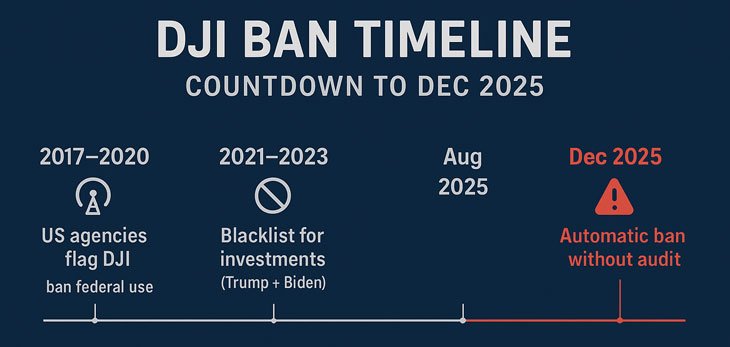
DJI Drone Ban Timeline & Key Stats 2025: US Government Ban Impact
Impacts include no-fly zones, airspace rules, counter-drone measures. Businesses seek alternatives to DJI like Autel drones, Skydio drones, Parrot drones amid Chinese technology & US-China trade war concerns.
The DJI Drone Ban Timeline & Key Stats 2025 outlines critical milestones in the regulatory actions targeting DJI drones, DJI, the leading China drones manufacturer, amid U.S. national security concerns including spyware allegations and backdoor access risks. These dates mark escalating restrictions on sales, imports, and usage of DJI products by federal agencies and potentially broader markets under FAA regulations and Part 107 remote ID requirements.
Timeline Milestones highlight four pivotal events including BIS entity list designations. The NDAA Deadline in 2025 refers to the defense authorization act’s enforcement via the National Defense Authorization Act, mandating federal agencies like DoD policy and Homeland Security to divest from DJI drones including Mavic series, Phantom series, Agras series, Matrice series, and FPV drones by year’s end due to risks of telemetry data transmission to foreign adversaries. This builds on prior bans like firmware bans, software restrictions, sales prohibition, and military use restrictions, pushing for complete prohibition of DJI equipment in government procurement, critical infrastructure, and private sector use per compliance requirements.
- FCC Vote Expansion (1018): Likely denoting October 18th (10/18), this FCC restrictions vote expanded the list of banned Chinese tech entities under the “covered list,” effectively blocking DJI drones from receiving FCC certification. Without certification, new DJI models cannot be legally sold or imported in the U.S., severely impacting market availability.
- DJI Binding Policy (2025): Set for full implementation in 2025, this policy finalizes binding rules prohibiting DJI use across federal, state, and local government entities, including law enforcement and emergency services, amplifying the scope beyond initial proposals.
- DJI Sales Pause (1016): On October 16th (10/16), major U.S. retailers like Amazon paused DJI drone sales pending FCC clarity, reflecting voluntary compliance amid regulatory pressure and signaling immediate commercial fallout.
These milestones reveal a tightening regulatory noose around DJI, driven by cybersecurity fears over potential surveillance capabilities. The sequence-from sales pauses and FCC actions in late 2024 (1016 and 1018)-culminates in 2025’s NDAA deadline and binding policy, projecting widespread unavailability of DJI products. This could disrupt industries reliant on DJI’s affordable, high-performance drones, such as agriculture, filmmaking, and public safety, forcing a shift to costlier U.S. or allied alternatives to DJI.
Businesses and consumers must prepare by exploring compliant options early. The timeline underscores the urgency of adapting to a post-DJI U.S. drone market, potentially fostering domestic innovation while raising prices industry-wide.
What Are DJI Drones?
DJI drones feature advanced specs including Mavic 3’s 46-minute flight time, 5.1K video, OcuSync 3.0 transmission with 15km range, and omnidirectional obstacle avoidance. These multirotor drones lead with 77% US consumer market share in 2023, powering everything from recreational flying to professional applications. Key technologies include APAS 5.0 avoidance for safer flights, RTK positioning for precise mapping, and LiDAR sensors for enhanced autonomy. Models like DJI Mini suit hobby drones under 250g for no registration needs, while Mavic series excel in commercial drones with gimbal stabilization and thermal imaging options. Drone legality questions arise from FCC restrictions on radio frequency and geofencing via FlySafe database, ensuring compliance with no-fly zones and TFRs.
| Model | Weight | Flight Time | Camera | Price | Best For |
|---|---|---|---|---|---|
| Mavic series DJI Mini 4 Pro | 249g | 34min | 4K | $759 | recreational |
| DJI Air 3 | 720g | 46min | 4K/60fps | $1,099 | travel |
| Mavic 3 Pro | 958g | 43min | 5.1K | $2,199 | professional |
| Phantom series Phantom 4 | 1,380g | 28min | 4K | $1,499 | filmmaking |
| Matric 300 RTK | 6,310g | 55min | Thermal/20MP | $12,000 | enterprise |
These specs support wind resistance, IP rating for durability, and payload capacity for delivery drones or construction monitoring. DJI’s OcuSync technology and Lightbridge ensure reliable transmission, with CE FCC certification and RoHS compliance. For Part 107 certified pilots, features like mission planning via DJI SDK aid sUAS operations, though DJI ban concerns and firmware updates raise NDAA compliance issues for government contracts.
Current Legal Status in the United States
DJI drones remain legal for private US consumers but prohibited for federal agencies under NDAA Section 889 since 2020. The FY2020 National Defense Authorization Act introduced a procurement ban targeting Chinese technology in government systems, followed by DoD prohibitions on operational use. Proposed 2024 bills like the Countering CCP Drones Act seek broader consumer restrictions, while the FCC, alongside the Treasury Department and Commerce Department, began revoking DJI authorizations in December 2024 over national security concerns. These measures distinguish hobby drones and commercial use by individuals from government contracts and public safety drones. Private owners face no outright ban, but must follow standard FAA rules for airspace compliance and registration.
Federal restrictions focus on cybersecurity risks from DJI’s data transmission and potential ties to Chinese government access. Consumer legality persists for models like DJI Mavic, DJI Air, and DJI Mini, as long as operators adhere to Remote ID and no-fly zones. Ongoing congressional efforts, including the Secure ENFORCE Act amid the US-China trade war, aim to expand the DJI ban to state laws and local regulations, impacting law enforcement drones and first responders. Private users should monitor CISA alerts for firmware updates and supply chain risks to maintain drone legality.
Distinguishing these layers helps clarify that while US drone bans apply to agencies, everyday pilots enjoy fewer hurdles. For instance, recreational flying with DJI Phantom remains permitted below 400 feet in uncontrolled airspace, provided B4UFLY app checks confirm no TFRs. This setup balances innovation in agriculture drones and filmmaking with national security, though geopolitical tensions drive calls for American-made alternatives like Skydio drones.
DJI drones comply with FAA Part 107 and Remote ID requirements when registered, but face federal procurement bans under NDAA FY2021 Section 889. Key UAV regulations include FAA registration for all drones over 250g at a $5 fee, mandatory Remote ID broadcasting since 2023, and Part 107 certification via a $175 test for commercial operations. The NDAA bans DoD and DHS purchases, while the proposed Countering CCP Drones Act threatens consumer access to China drones.
Compliance ensures drone legality for both hobby and enterprise use. A checklist includes verifying geofencing via FlySafe database, obtaining LAANC approvals for controlled airspace, and carrying drone insurance for liability. Violations carry steep penalties, such as a $32,666 fine for an unregistered commercial flight in FAA’s 2023 enforcement actions. DJI models like DJI Mini meet weight exemptions for recreational flying, but all require operator awareness of TFRs and no-fly zones near airports.
- Register drones over 250g on FAA website within 10 days of purchase.
- Equip with Remote ID modules or use compliant firmware.
- Pass Part 107 exam for paid work like real estate videography.
- Avoid NDAA-prohibited sales to government entities amid enforcement actions.
- Monitor proposed bills and approved vendor lists for future drone restrictions.
These rules promote safe integration of commercial drones while addressing sanctioned drones concerns.
_2.jpeg)
NDAA Section 889 bans DJI drones from federal procurement since August 2020, affecting 37 agencies including DoD, DHS, and first responders. Implementation rolled out in phases: FY2020 limited DoD bans, FY2021 expanded to all federal use, and FY2023 reported $3.4 billion in compliance costs for inventory replacement. Prohibited use cases span police departments with $1.2 billion in law enforcement drones, fire departments for search and rescue, and Border Patrol operations.
CISA advisories highlight cybersecurity risks like data security vulnerabilities in OcuSync technology and potential drone hacking through communication protocols, alongside NIST guidelines. Waivers allow temporary use but expire in 2025 under waiver programs and temporary reprieves, with $200 million allocated for transitions to Autel drones, Skydio drones, or Parrot drones. Agencies must divest existing DJI Phantom and Mavic fleets, impacting public safety drones in emergency response and thermal imaging missions.
- DoD policy prohibits operational deployment since 2020.
- DHS guidelines ban imports under entity list rules.
- First responders phase out for RTK positioning and LiDAR tasks.
- Waiver requests require BIS approval for national security exceptions.
- Replacement funding supports American-made drones amid trade sanctions.
This framework underscores NDAA compliance priorities, pushing drone manufacturers toward reshoring and reducing reliance on Chinese technology for mission planning and autonomous flight.
International Restrictions on DJI Drones: global drone laws, Australia regulations, Canada rules, UK CAA, EASA standards, and ICAO guidelines
While US focuses on US government ban and procurement bans, Australia with Australia regulations and Canada with Canada rules have outright DJI restrictions for government use. These measures reflect broader concerns over national security and cybersecurity risks tied to Chinese technology and China drones in drones. In contrast, the EU and UK emphasize security reviews rather than full prohibitions, allowing compliant models under aviation rules. Outright bans remain limited globally, often confined to public sector or military applications.
For instance, EASA Open Category compliance enables hobby and commercial use of many DJI Mini and DJI Air series in Europe, provided they meet C-class labeling. National security directives, like those from CISA advisories, highlight data transmission risks via communication protocols. Australia imposed its government contracts ban in 2022, citing supply chain risks, while Canada’s policy mirrors this for federal procurement. Such drone restrictions push agencies toward alternatives to DJI like Skydio drones or Autel drones models with NDAA compliance. Operators must check local UAV FAA regulations, including remote ID and geofencing via FlySafe database, to avoid fines or confiscation. This patchwork of drone laws underscores the need for drone pilots to verify legality before flights.
International approaches vary by threat perception. The DoD policy and Secure ENFORCE Act target Chinese drones in enterprise settings, like public safety drones for first responders. EU policies balance innovation with privacy concerns, mandating firmware updates and data security audits. Australia’s CASA rules enforce the ban on DJI for official use, impacting law enforcement drones and search and rescue operations. Globally, over 50 countries conduct reviews, but few enact total import bans. Trade sanctions and export controls from BIS restrictions further complicate resale value and warranty for sanctioned drones. Hobbyists flying consumer drones like DJI Mavic face fewer hurdles outside government scopes, yet must adhere to airspace rules, TFRs, and B4UFLY app checks.
EU classifies DJI drones as C0 C1 C2 categories C1-C4 under EASA standards but subjects Chinese manufacturers to cybersecurity reviews. Models like Mini 3 Pro (C1) and Mavic series Mavic 3 (Specific category) gain approval with CE marking and RoHS compliance, allowing recreational flying and commercial drones in Open Category. Germany’s BSI warnings flag data security issues in OcuSync technology and SDK integrations, urging operators to disable cloud features.
UK CAA requires drone registration for devices over 250g, with government security reviews banning DJI from sensitive missions. Latvia enacted a complete government ban in 2023, prohibiting all public sector use due to hacking fears. These policies ensure drone legality through certification, yet highlight privacy concerns in autonomous flight and thermal imaging apps.
Certification demands include FCC restrictions on radio frequency compliance and obstacle avoidance testing. EU drone laws permit Part 107-like operations for sUAS, with LAANC equivalents for no-fly zones. UK policies align closely, restricting Phantom series DJI Phantom and Air series in controlled airspace without operator licenses. Enterprise users in filmmaking or surveying must weigh cybersecurity risks against features like RTK positioning and 4K cameras in the drone ecosystem. Advocacy groups note AUVSI positions favoring regulated use over outright DJI blacklist entries. Pilots should verify EASA rules for gimbal stabilization and battery life limits to maintain insurance coverage and avoid criminal penalties.
Other Countries’ Bans
Australia banned DJI from government procurement (2022), Taiwan prohibited military use, while India maintains 2020 international bans import ban. These actions stem from national security and supply chain risks, reshaping markets. India’s ban shifted 100% domestic market to Parrot drones alternatives like Garuda Aerospace, boosting local drone manufacturers. Taiwan limits China drones near borders, citing espionage via communication protocols. Ukraine’s wartime measures ban DJI for frontline operations, favoring Western brands amid geopolitical tensions. Such drone prohibitions impact agriculture drones and delivery trials, like those by Amazon Prime Air equivalents.
Broader effects include economic ripples, stifling innovation in real estate videography and construction monitoring. Operators face customs seizure and fines for illegal drones. The table below summarizes key restrictions:
| Country | Status | Date | Scope | Reason |
|---|---|---|---|---|
| Australia | Government ban | 2022 | Federal procurement | Cybersecurity risks |
| Taiwan | Military prohibition | Ongoing | Military and defense | National security |
| India | Import ban | 2020 | All imports | Geopolitical tensions |
| Latvia | Government ban | 2023 | Public sector | Data security |
| Lithuania | Security review | 2022 | Government use | Supply chain risks |
| Ukraine | Wartime ban | 2022 | Military operations | Wartime measures |
This overview aids drone pilots in navigating global drone bans and selecting legal secure drone solutions alternatives like Parrot drones for compliance.
Reasons Behind DJI Restrictions
US intelligence risk assessments identify DJI as a national security risk due to data transmission to Chinese servers and firmware vulnerabilities. Primary concerns involve data exfiltration, where flight logs and imagery flow to servers in China, supply chain vulnerabilities similar to past cyberattacks, intellectual property theft, and Beijing’s National Intelligence Law that requires company cooperation with state intelligence efforts. Specific incidents, like the 2023 Bulgarian analysis showing geofencing bypasses, and official reports from CISA highlight these issues. The DoD’s 2020 report flagged firmware backdoors, while a University of Texas study demonstrated 90% success in hacking DJI models. These factors drive drone restrictions in government use and federal procurement under NDAA compliance rules.
Congressional hearings on congressional bills such as the Secure ENFORCE Act and Countering CCP Drones Act aim to enforce a DJI ban for public safety drones, first responders, and law enforcement. Homeland Security DHS guidelines and CISA advisories underscore cybersecurity risks from Chinese technology, including potential remote ID manipulation and communication protocols vulnerabilities. Export controls and BIS entity list BIS restrictions add layers to UAV regulations, impacting commercial drones, hobby drones, and consumer models like DJI Mavic, DJI Phantom, and DJI Mini. Trade sanctions reflect broader US-China trade war relations and technology decoupling efforts.
These federal mandates restrictions affect drone legality across sectors, from enterprise drones in agriculture and surveying to filmmaking. While FAA rules like Part 107 and remote ID still apply, DJI’s FlySafe database and geofencing raise privacy concerns. Alternatives like Autel drones, Skydio drones, and American-made options gain traction amid the drone prohibition push.
CISA’s 2022-2024 alerts document DJI drones transmitting flight logs, coordinates, and imagery to Chinese servers without user consent, fueling national security fears per vulnerability reports. This data exfiltration violates privacy norms and enables potential surveillance, as outlined in CISA Alert AA24-235A. Firmware backdoors, detailed in the DoD’s 2020 report, allow unauthorized access, mirroring risks in other Chinese tech. A University of Texas drone hacking study achieved a 90% success rate on popular DJI models, exposing cybersecurity risks in real-world scenarios.
- Data transmission to Chinese servers, per CISA Alert AA24-235A, captures sensitive location data from consumer drones and enterprise models.
- Firmware backdoors identified in DoD 2020 report, enabling remote control overrides in public safety drones.
- Geofencing manipulation revealed in 2023 Bulgarian analysis, bypassing no-fly zones and TFRs for DJI Air and DJI Mini.
- Supply chain vulnerabilities, compared to SolarWinds attack, affect drone manufacturers and ground control stations.
- Compliance with China’s 2017 NIS Law, mandating intelligence cooperation and raising concerns for US government ban implications.
These risks extend to FCC restrictions on radio frequency use and OcuSync technology, prompting BIS entity list placement and federal procurement bans. Lawmakers cite them in pushing NDAA compliance for first responders and DoD policy updates.
Can Consumers Still Use DJI drones?
Private US consumers can legally purchase and fly DJI drones for recreational use under FAA TRUST certificate. This free online training distinguishes hobby drones from commercial operations, which need Part 107 certification costing $175. Government entities face US government ban through NDAA bans on China drones due to national security and cybersecurity risks. As of 2024, no nationwide DJI ban exists for consumers, but drone registration applies to models over 0.55 pounds via FAA DroneZone.
Pending bills like the Countering CCP Drones Act and Secure ENFORCE Act propose adding DJI to the BIS entity list, risking future import bans or FCC restrictions on radio frequency communications. Recreational pilots must follow airspace rules, remote ID requirements, and no-fly zones using the B4UFLY app. Commercial users require LAANC authorization for controlled airspace. Experts note DJI’s 70% market share persists despite concerns over data security, Chinese technology, and FlySafe geofencing. Consumers should monitor CISA alerts and congressional updates to stay compliant with evolving drone laws.
Flying consumer drones like DJI Mini or Mavic series demands awareness of TFRs and VLOS rules. Registration costs $5 for three years, mandatory since 2015 for most UAVs. TRUST completion takes 30 minutes and covers basic safety. Violations lead to fines up to $32,666 per incident. Alternatives like Autel drones or Skydio drones offer NDAA compliance options for those wary of sanctioned drones. Public safety applications, such as search and rescue, highlight DJI’s thermal imaging strengths, yet supply chain risks prompt firmware scrutiny.
_3.jpeg)
Recreational pilots need free FAA TRUST certificate; commercial operators require Part 107 ($175 exam, renewable every 2 years). This certification mandates knowledge of FAA regulations, weather minimums, and preflight inspections for sUAS. In 2024, FAA reported 1,200 Part 107 violations with total fines of $1.2 million, often for operations beyond visual line of sight or in restricted areas. Recreational use limits flights to 400 feet altitude without waivers, ideal for hobbyists capturing aerial photography with DJI Air series. Commercial pilots handle tasks like real estate videography or agriculture surveying, needing liability insurance.
| Use Type | Certification | Insurance | Restrictions | Examples |
|---|---|---|---|---|
| Recreational | TRUST (free) | $0-$500 policy | <400ft, VLOS, no pay | Filmmaking with Phantom series, park flying DJI Mini |
| Commercial | Part 107 ($175) | $1M policy | LAANC auth, Remote ID | Construction monitoring, delivery with DJI Mavic |
| Government | NDAA banned | N/A | No procurement | First responders, law enforcement prohibited from non-DJI compliant options |
Insurance providers like SkyWatch offer policies at $10/month, while BWI provides annual coverage for $500. Drone restrictions intensify for enterprise drones like Agras series and Matrice series in no-fly zones near airports or stadiums. Recreational flyers avoid Part 107 complexity but must yield to manned aircraft. Commercial operators benefit from OcuSync transmission for longer range, yet face cybersecurity scrutiny on communication protocols. AUVSI advocates balanced UAV regulations to protect innovation in emergency response without stifling consumer access.
Alternatives to DJI Drones
Skydio drones 2+ ($1,099) offers superior autonomy while Autel drones EVO Nano+ ($949) matches DJI specs with NDAA compliance. These alternatives to DJI address concerns over drone legality and the US government ban tied to Chinese technology. With DJI facing restrictions from the Countering CCP Drones Act and BIS entity list placement, pilots seek legal drone brands like Parrot drones that meet FAA regulations and avoid cybersecurity risks. Market data shows DJI’s market share dropping from 70% to 55% in 2024, as users shift to compliant options for hobby drones, commercial drones, and public safety drones. For instance, first responders now prefer models with secure communication protocols over DJI Mavic or DJI Air series.
Key factors in choosing alternatives include drone restrictions, data security, and features like autonomous flight or obstacle avoidance. NDAA compliant drones ensure eligibility for government contracts and enterprise drones, unlike sanctioned DJI drones from DJI. Budget options like Potensic ATOM suit recreational flying under Part 107, while high-end picks like Parrot Anafi USA serve law enforcement drones with advanced zoom. Users benefit from geofencing, remote ID, and FlySafe database integration without privacy concerns from Chinese manufacturers. This shift supports domestic alternatives and reshoring manufacturing amid US-China relations tensions.
Below is a comparison of top alternatives to DJI, highlighting price, flight time, camera quality, and ideal uses. These models offer strong wind resistance, transmission range, and 4K cameras comparable to DJI Phantom, making them viable for aerial photography, search and rescue, or agriculture drones.
| Brand | Model | Price | Flight Time | Camera | NDAA Compliant | Best For |
|---|---|---|---|---|---|---|
| Skydio | 2+ | $1,099 | 27min | 4K | Yes | autonomy |
| Autel | EVO Nano+ | $949 | 28min | 4K | Yes | consumer |
| Parrot | Anafi USA | $10,000 | 32min | 32x zoom | Yes | gov |
| Potensic | ATOM | $300 | 32min | 4K | Yes | budget |
| Holy Stone | HS175D | $250 | 46min | 4K | Yes | entry-level |
Future Outlook and Updates
The Countering CCP Drones Act, passed by the House in October 2024, could ban new DJI sales by 2027 if reconciled with the Senate. This legislation targets China drones due to ongoing national security and cybersecurity risks, potentially reshaping drone legality for consumer and commercial users. Experts predict a 35% price increase for alternatives to DJI like Autel drones, Skydio drones, and Parrot drones as demand surges.
Hobbyists flying DJI Mini or DJI Mavic models may face drone restrictions on repairs and firmware updates, while enterprise users in agriculture drones and surveying mapping adapt to NDAA compliance. Tracking key congressional bills and future legislation such as the Secure ENFORCE Act, DJI Autonomy Mandating Ban, and Defense Logistics Act will be crucial for drone pilots navigating UAV regulations.
Four potential scenarios outline the trajectory of the DJI ban. First, a consumer ban in 2027 could disrupt 70% of the drone industry association market, forcing replacements for popular consumer drones like DJI Air and DJI Phantom. Second, FCC delisting in Q2 2025 would cut access to repair parts, impacting radio frequency certifications and OcuSync technology. Third, expiring NDAA waivers in 2025 might require $500 million in replacements for public safety drones used by first responders and law enforcement amid DoD policy. Fourth, ongoing legal challenges in the DJI vs FCC lawsuit could delay or alter FCC restrictions, affecting data security and communication protocols.
Drone operators should monitor CISA advisories and DHS guidelines from Homeland Security for updates on sanctioned drones. Alternatives like American-made trusted providers offer NDAA compliance but at higher costs due to supply chain risks from Chinese technology amid US-China trade war. The drone industry impact includes stifled innovation in thermal imaging and LiDAR sensors, yet opportunities arise in reshoring manufacturing. Recreational flying under FAA rules and Part 107 certification remains unaffected short-term, but long-term drone prohibition could raise resale values and void warranties on existing DJI drones.
Scenario 1: Consumer Ban by 2027
A full consumer ban on DJI drones by 2027 would cause 70% market disruption, hitting hobby drones hardest. Users of FPV drones like DJI Mini series, prized for 4K cameras and 30-minute flight time, might see confiscation risks during FAA inspections or TFRs. This stems from Countering CCP Drones Act provisions targeting import bans and customs seizures of China drones.
Commercial operators in filmmaking drones and real estate videography would pivot to legal drone brands, facing 35% higher prices. Actionable tip: Inventory current fleets now and explore drone insurance implications for liability coverage against drone laws changes. Drone manufacturers like Skydio emphasize autonomous flight to compete on obstacle avoidance and transmission range.
Scenario 2: FCC Delisting in Q2 2025
FCC delisting and FCC restrictions expected in Q2 2025 would sever repair parts for Phantom series and DJI Mavic, voiding CE FCC certification. This hits communication protocols like Lightbridge, raising cybersecurity risks in enterprise drones for construction monitoring and search and rescue.
Hobbyists risk grounded quadcopters without batteries or gimbals, per FCC restrictions. Tip: Stockpile parts via FlySafe database checks and geofencing compliance. Market share shifts favor Parrot drones with IP rating and wind resistance suited for public safety drones.
Scenario 3: NDAA Waivers Expire in 2025
Expiring NDAA waivers in 2025 demand $500 million in replacements for government contracts, DoD policy, and federal procurement. Law enforcement drones and first responders using DJI SDK for mission planning face drone hacking concerns from BIS restrictions and entity list status.
Agriculture drones like Agras series for payload capacity and RTK positioning switch to Autel drones. Tip: Audit for NDAA compliance using B4UFLY app and LAANC for airspace rules. Economic effects include drone industry impact on stock prices and investor concerns amid US-China trade war tensions.
Scenario 4: Legal Challenges (DJI vs FCC Lawsuit)
The DJI vs FCC lawsuit challenges FCC restrictions on drone restrictions regarding privacy compliance concerns and data security, potentially delaying US drone ban or broader US government ban. Advocacy groups like AUVSI argue against innovation stifle in multirotor DJI drones and sUAS.
Outcomes could preserve remote ID and drone registration for commercial drones. Tip: Follow court filings,petitions, and lobbying efforts for impacts on export controls and trade sanctions. Global parallels in EASA standards and EU drone laws highlight geopolitical tensions.
Tracking Key Bills
_4.jpeg)
Monitor three critical congressional bills: Secure ENFORCE Act mandates drone legality audits; DJI Autonomy Mandating Ban targets autonomous flight risks; Defense Logistics Act enforces supply chain risks in defense logistics.
- Secure ENFORCE Act: Enhances CISA advisories on illegal drones.
- DJI Autonomy Mandating Ban: Bans geofencing flaws.
- Defense Logistics Act: Blocks Chinese technology in DoD policy.
These could trigger 35% price hikes with sunset clauses and exemptions criteria, urging shifts to alternatives to DJI like American-made Skydio drones and Parrot drones for emergency response and delivery drones like UPS Flight Forward.
Frequently Asked Questions
Are DJI drones illegal?
No, DJI drones are not illegal. They are widely used recreational and professional UAVs compliant with FAA regulations in the US and similar rules elsewhere, as long as operators follow local laws on registration, airspace, and flight restrictions like VLOS rules.
Are DJI drones illegal in the United States?
DJI drones are legal in the US but must be registered with the FAA if over 0.55 pounds (250g). Users need to pass The DroneZone test for recreational flying and adhere to no-fly zones via controller apps like DJI Fly, which integrates geofencing for compliance with Part 107 standards.
Are DJI drones illegal to buy?
It is legal to buy DJI drones from authorized retailers or directly from DJI‘s website, including the second-hand market and refurbished drones. There are no blanket bans on purchasing them, though some government entities like Treasury Department, Commerce Department, and BIS entity list may have procurement restrictions due to security concerns.
Are DJI drones illegal for commercial use?
DJI drones are not illegal for commercial use; many businesses use models like the Mavic series or Phantom series. Commercial operators require an FAA Part 107 certification, remote ID compliance, and must obtain necessary waivers for BVLOS operations beyond visual line of sight.
Are DJI drones illegal because of security issues?
DJI drones are not illegal despite past security concerns raised by the US government about data transmission and China drones risks. DJI has implemented Local Data Mode, onboard processing, and firmware updates to address these with data sovereignty, and no outright ban exists for civilian users following regulations and Homeland Security CISA advisories.