Drones in Formation: The Future is Now

Drone swarms are rapidly evolving, moving from simple coordinated flights to complex, autonomous operations. Here are the main points to remember about this developing technology:
Key Takeaways
- Drones are moving from being controlled one by one to working together as a team, a concept known as swarming.
- This technology can speed up tasks like searching for people, watching areas, and creating maps.
- Military applications are a big driver for drone swarm development, promising better efficiency and lower costs.
- Making drones smarter and able to talk to each other reliably is a major technical challenge.
- Simple drone swarms are becoming available, but complex ones require significant resources and expertise to build.
The Dawn Of Autonomous Collaboration
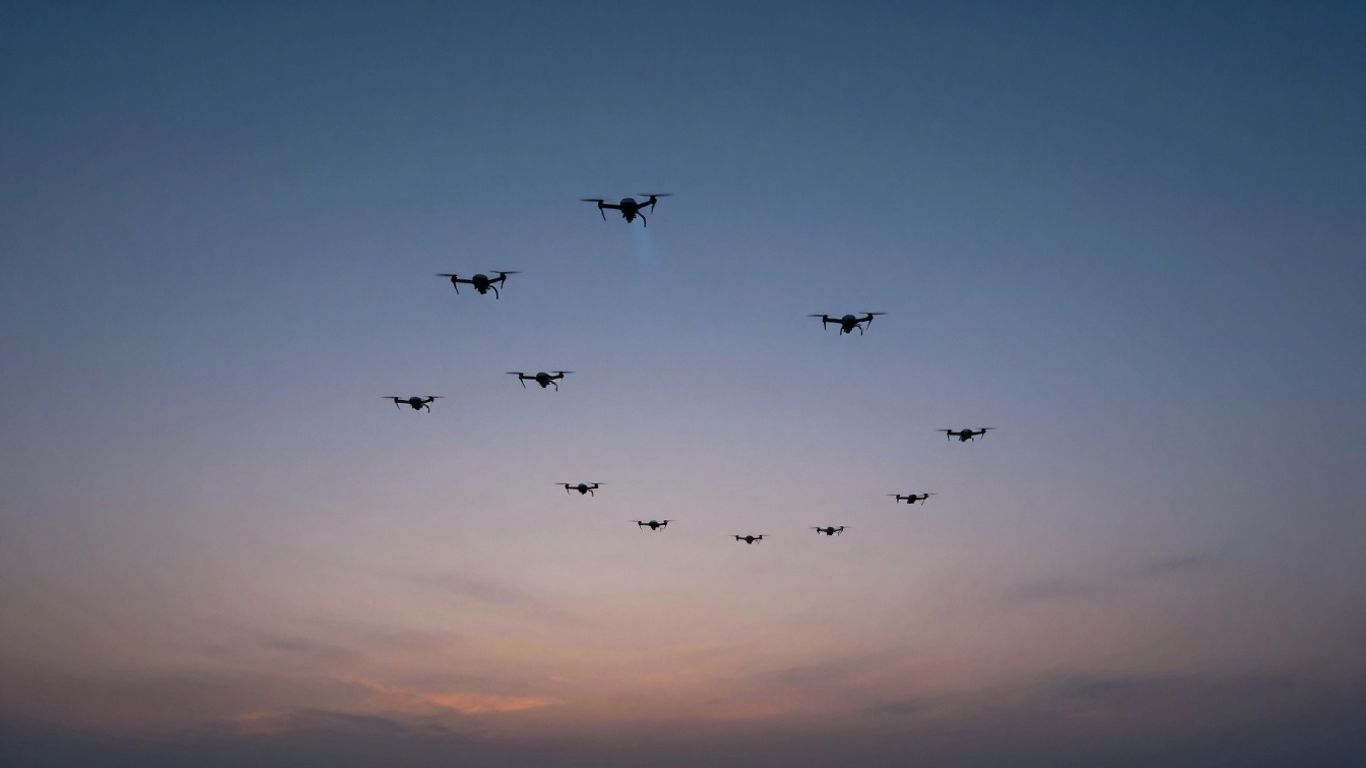
We’re seeing a big shift in how drones work. It’s moving away from one person flying one drone to something much bigger: multi-drone collaboration. Think about it like a flock of birds or a school of fish; they move and act together without a single leader telling each one what to do. This is the core idea behind drone swarms. Instead of just following a set path, these drones can actually talk to each other and make decisions as a group. This allows them to do tasks that a single drone just can’t handle.
From Single Control To Collective Purpose
Remember when controlling a drone meant you were glued to the controller, focused on just that one machine? That’s changing fast. Now, we’re looking at systems where one operator can oversee a whole group of drones, or even better, the drones can coordinate themselves. This collective purpose is what makes swarms so powerful. They can cover more ground, react faster, and complete jobs more efficiently than individual units.
- Increased Efficiency: Tasks get done quicker with more eyes in the sky.
- Enhanced Resilience: If one drone has an issue, others can pick up the slack.
- Complex Task Execution: Operations too difficult for a single drone become possible.
This move towards autonomous collaboration is a huge step, opening up possibilities we’re only just starting to explore. It’s about moving from simple remote control to true teamwork in the air, a concept that’s already being explored for things like long-distance cargo transport.
Beyond Preprogrammed Formations
Flying in a pretty pattern for a light show is cool, sure. But that’s just the beginning. The real magic happens when drones can adapt. Imagine a search and rescue mission where the swarm needs to change its search pattern because of new information, or a military operation where they have to react to unexpected threats. This requires a level of awareness and communication between the drones that goes way beyond just following a script. They need to share data, understand the overall goal, and adjust their individual actions to help the group succeed.
The ability for drones to communicate and make group decisions in real-time is what separates simple drone flights from true autonomous collaboration. This adaptability is key to tackling unpredictable environments and complex objectives.
Nature’s Blueprint For Drone Swarms
It’s no accident that many of these ideas come from observing nature. Think about how ants work together to find food or how birds fly in formations to save energy. These natural systems have perfected coordination over millions of years. We’re essentially trying to replicate that intelligence and cooperation in our machines. By studying how these biological swarms operate, we can develop better algorithms and strategies for our own drone swarms, making them more effective and efficient for a wide range of advanced autonomous operations.
Transforming Operations With Swarm Intelligence
Think about how much faster things could get done if you had a whole team working together, not just one person. That’s the basic idea behind drone swarms. Instead of a single drone doing a job, a group of them can tackle tasks much more efficiently. This isn’t just about having more eyes in the sky; it’s about coordinated action. For instance, imagine a search and rescue mission. A swarm could cover a much larger area in a fraction of the time it would take a single drone, significantly speeding up the process. This collective approach promises to revolutionize how we handle complex operations.
Accelerating Search, Surveillance, And Mapping
When disaster strikes, every second counts. Drone swarms can dramatically cut down the time needed for critical tasks like finding missing people or assessing damage after a natural event. They can fan out over an area, providing real-time video feeds and data that would be impossible for a single unit to gather. This allows response teams to make quicker, more informed decisions. For mapping, a swarm can create detailed 3D models of terrain or infrastructure far faster than traditional methods. It’s like having an entire aerial survey crew working in perfect sync.
Enhancing Military Logistics And Detection
In military contexts, drone swarms offer a significant advantage. They can be used for reconnaissance, providing constant surveillance of an area without risking manned aircraft. For logistics, swarms could potentially deliver supplies to difficult-to-reach locations. They are also being developed for detecting threats, such as identifying improvised explosive devices or enemy positions. The ability of multiple drones to work together means they can cover more ground and provide a more complete picture of the operational environment. This kind of advanced surveillance is a key development in modern defense AI-powered drone swarms.
The Promise Of Lower Operating Costs
While the initial investment in swarm technology might seem high, the long-term benefits can lead to reduced operating expenses. By automating tasks that previously required multiple people or expensive equipment, swarms can cut down on labor costs. Furthermore, the resilience of a swarm means that if one or two drones are lost, the mission can often continue with the remaining units. This redundancy reduces the impact of individual failures. Think about the cost savings in areas like infrastructure inspection or agricultural monitoring, where swarms could perform tasks more frequently and at a lower cost per mission.
The core advantage of drone swarms lies in their ability to perform tasks collaboratively. This collective intelligence allows them to achieve objectives that would be impossible for individual drones, leading to greater efficiency and effectiveness across a wide range of applications. The coordination and communication between drones are key to unlocking this potential.
Here’s a look at how swarms can improve operations:
- Speed: Cover larger areas or complete tasks much faster.
- Efficiency: Reduce the number of personnel or equipment needed.
- Resilience: Continue operations even if some units are lost.
- Data Collection: Gather more comprehensive information in less time.
This technology is rapidly evolving, with potential applications ranging from environmental monitoring to complex industrial inspections, and even assisting in emergency services like those provided by restoration experts when damage occurs.
Navigating The Technical Landscape
Developing Smarter, More Aware Drones
Making drones work together isn’t just about getting them to fly in a straight line. It’s about giving them a kind of shared brain. We’re talking about drones that can figure things out on their own, not just follow orders. This means they need to sense their surroundings, understand what other drones are doing, and make decisions without a human telling them every single step. Think of it like a flock of birds – they move as one, but each bird is also watching out for itself and its neighbors. This collective intelligence is what makes drone swarms so powerful. It’s a big step up from just pre-programmed flight paths. We’re seeing advances in sensors and processing power that allow drones to adapt to unexpected situations, like a sudden obstacle or a change in weather. It’s a complex area, and getting it right is key for future drone operations.
Establishing Robust Inter-Drone Communication
For a swarm to function, the drones have to talk to each other, and they need to do it reliably. This isn’t like your Wi-Fi at home; it’s about creating a network that’s tough and can handle a lot of information flying around. If one drone loses connection, the others need to pick up the slack. We’re looking at different ways to make this happen, like mesh networks where each drone acts as a relay point. The goal is to have communication that’s fast, secure, and can work even if some drones are damaged or out of range. It’s a bit like a secret code that only the swarm understands, allowing them to coordinate complex maneuvers without a central command post. This kind of communication is vital for tasks like search and rescue, where quick information sharing can make all the difference.
Integrating Swarms Into Future Airspace Management
So, we’ve got these smart, talking drones. Now, how do they fit into the sky with everything else? That’s the big question for airspace management. Right now, the sky is pretty regulated, and a swarm of hundreds or thousands of drones is a whole new ballgame. We need systems that can track them, manage their flight paths, and keep them from bumping into planes, other drones, or even buildings. It’s not just about keeping things safe; it’s about making sure swarms can operate efficiently without causing chaos. This involves developing new rules and technologies that can handle this level of autonomous activity. It’s a challenge, but it’s necessary if we want to see swarms used for things like delivering packages or helping out during emergencies. The development of autonomous drone swarm formation is pushing these boundaries.
The Evolving Military Drone Swarm Technology
From Combat Zones To Global Battlefields
The way we fight is changing, and drones are a big part of that. We’re seeing a shift from individual drones acting alone to groups of them working together. This isn’t just about having more eyes in the sky; it’s about creating a networked force. Think about it: instead of one drone doing a job, a whole team can tackle it, sharing information and covering more ground. This evolution is happening fast, moving from smaller conflicts to potentially global-scale operations. The idea of aerial drone units becoming standard is no longer a distant thought.
The Rise Of Autonomous, Saturated Attacks
One of the most talked-about aspects is the concept of saturation attacks. Imagine a swarm of drones, all acting with a degree of autonomy, overwhelming an enemy’s defenses. This isn’t just about numbers; it’s about coordinated action. AI in drone warfare is making these systems smarter, allowing them to adapt and react in real-time. This means they can identify targets, adjust their approach, and even communicate with each other to achieve a common goal without constant human input. It’s a significant step up from pre-programmed flight paths. The development of FPV drones has shown how agile and effective even smaller, less complex systems can be when used tactically.
Integrating Multiple Drones For Shared Objectives
Developing these coordinated drone operations means tackling some serious technical hurdles. We need drones that can talk to each other reliably, share data, and understand their collective mission. This involves creating robust inter-drone communication networks. The goal is to have multiple drones, perhaps even different types, working together towards a shared objective. This could mean anything from reconnaissance and surveillance to more direct action. The complexity grows when you consider how these swarms will fit into the larger picture of air traffic management and how they’ll interact with other military assets. It’s a complex puzzle, but one that’s actively being solved.
The push towards autonomous aerial systems is driven by the need for greater efficiency and reduced risk to human personnel. By distributing tasks across a network of unmanned aerial vehicle networks, military forces can achieve objectives that would be too dangerous or resource-intensive for traditional methods. This collaborative approach promises to redefine battlefield dynamics.
Understanding Proliferation Dynamics
The Speed of Small, Homogenous Swarms
When we talk about drone swarms spreading out there, it’s important to remember that not all swarms are created equal. The ones that are likely to show up everywhere first are the small, pretty much identical kinds. Think of a bunch of the same type of drone flying together. Building or buying a bunch of these isn’t super hard these days. We’re talking about technology that’s been around for a while, where even students have put together working swarms using off-the-shelf parts. The main challenge is getting them to talk to each other without messing up their signals and making sure the control systems work. But the basic know-how? It’s becoming more accessible. This means we should probably just assume these simpler swarms will become common, and maybe even encourage their spread among allies if they’re going to be a big part of future fights. It’s better if friends have them, right?
Acquiring Basic Swarm Capabilities
Getting a basic drone swarm up and running isn’t the same as building a super-advanced, stealthy one. For simpler swarms, the barrier to entry is getting lower. We’ve seen projects where commercial parts were used to create a swarm of fifty drones. The key parts are making sure the drones can communicate, usually through something like Wi-Fi, and setting up the command and control. It requires some technical skill, sure, but it’s not rocket science anymore. This ease of acquisition means that basic swarm capabilities are likely to spread. It’s a bit like how drones themselves have become so widespread. The Middle East, for instance, is already a place where non-state groups are using these kinds of advanced aerial systems in warfare.
Resource Constraints and Advanced Swarms
Now, when you get into the more complex stuff, that’s a different story. Building large, sophisticated swarms with advanced features like stealth or multi-domain capabilities takes a lot more money, specialized knowledge, and infrastructure. It’s like the difference between someone tinkering in their garage and a major defense contractor. States with limited resources might be able to put together small, basic swarms, but developing something truly cutting-edge, like swarms that can coordinate with fighter jets or operate deep underwater, is a much bigger hurdle. These advanced systems, which could really shift the balance of power, need much more careful thought regarding who gets them. We’re not talking about simple surveillance drones here; these are game-changers.
The effectiveness and spread of drone swarms will depend a lot on what they’re used for. A swarm designed to overwhelm enemy defenses will need different tech than one used for mapping disaster areas. This purpose-driven development means proliferation will look different depending on the swarm’s mission and the technology required to achieve it.
Future Applications And Challenges
Overwhelming Enemy Defenses
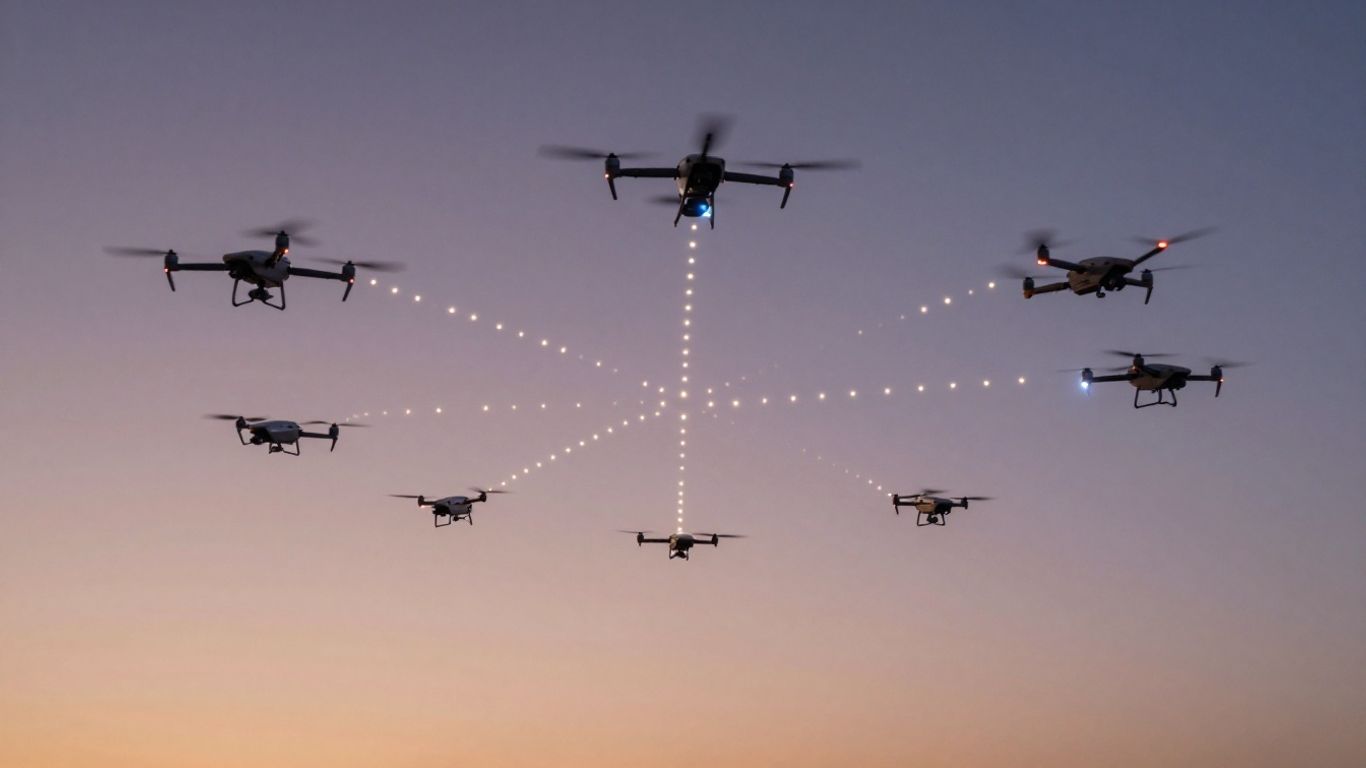
Think about it: instead of one big, expensive drone, you could have a whole bunch of smaller, cheaper ones working together. This swarm approach could be used to overwhelm enemy defenses. Imagine a wave of drones coming at a target from different directions. It would be incredibly difficult for any single defense system to track and stop them all. This coordinated chaos is a major advantage. It’s not just about brute force; it’s about smart tactics. The drones could even communicate with each other, sharing information about enemy positions and adjusting their attack patterns on the fly. This kind of adaptability is what makes drone swarms so interesting for future military operations. It’s a whole new way to think about air power, moving beyond single, high-value assets to a distributed, resilient force. The speed of small, homogenous swarms is a key factor here.
Maritime And Tactical Mortar Roles
Drone swarms aren’t just for the skies, either. We’re seeing ideas for them in maritime operations, too. Picture a fleet of underwater drones working together to map the seabed or track submarines. Or consider their use in tactical situations, like providing overwatch for ground troops or even acting as a sort of aerial mortar. A swarm could deliver payloads precisely where needed, or provide persistent surveillance over an area. The challenge, of course, is making sure these drones can operate reliably in tough environments, whether it’s the open ocean or a dusty battlefield. Developing smarter, more aware drones is a big part of this. The potential for lower operating costs is also a big draw for these kinds of applications.
Unknowns Shaping Swarm Effectiveness
Despite all the exciting possibilities, there are still a lot of unknowns when it comes to drone swarms. How do we ensure they can communicate reliably, especially in areas with a lot of electronic interference? What happens if one drone malfunctions – does it bring down the whole swarm? These are the kinds of questions that need solid answers before swarms become commonplace. We also need to think about the ethical implications and how to integrate them safely into existing airspace. The drone industry is experiencing rapid growth, but 2026 is expected to present challenges [d3dc].
The development of robust inter-drone communication is paramount. Without it, the collective intelligence and coordinated action that define a swarm simply cannot exist. This communication needs to be fast, secure, and resilient, capable of handling the dynamic and often unpredictable nature of swarm operations.
Here are some key challenges:
- Autonomy Levels: Determining the right amount of autonomy for each drone within a swarm. Too little, and they’re just remote-controlled toys; too much, and they might act unpredictably.
- Interference and Jamming: Protecting swarm communications from enemy electronic warfare.
- Scalability: Designing swarms that can grow or shrink based on mission needs, and that can incorporate different types of drones.
- Ethical Considerations: Establishing clear guidelines for the use of autonomous swarms, especially in conflict zones.
Commercial And Defense Interests Converge
Early Commercial Swarm Kits
It’s pretty wild how fast things are moving. Just a few years ago, drone swarms felt like something out of a sci-fi movie. Now, companies are already putting together basic swarm kits for commercial use. Think about light shows or synchronized aerial displays – that’s where a lot of this early commercial interest is focused. These kits are usually pretty straightforward, letting users control a small group of drones to perform simple, pre-programmed maneuvers. It’s a good starting point, showing people what’s possible without needing a degree in robotics. The real excitement, though, is how these commercial developments are feeding into more serious applications.
Defense Applications Driving Innovation
When you look at where the big money and serious brainpower are going, it’s definitely in defense. Militaries around the world are seeing the potential for drone swarms in ways that go way beyond just reconnaissance. We’re talking about overwhelming enemy defenses, creating diversions, or even acting as a distributed sensor network. This push from defense is really accelerating the technology. They need drones that can operate reliably, even when things get messy, and that means pushing the boundaries of what’s currently possible. It’s a bit of a feedback loop: defense needs drive innovation, and that innovation eventually trickles down to other sectors. It’s fascinating to see how quickly these advanced capabilities are being developed for the future battlefield.
Wildfire Mapping And Rescue Challenges
Beyond the military side, there’s a huge humanitarian angle. The 2018 wildfire season, for instance, was a wake-up call. Imagine using a swarm of drones to quickly map a raging wildfire, identifying hot spots and escape routes in real-time. Or think about search and rescue operations in disaster zones. Drones could cover vast areas much faster than ground teams, potentially saving lives. However, there are big challenges. Operating drones in smoky, unpredictable conditions, especially when GPS signals might be unreliable, is tough. Plus, getting a swarm to work effectively in such chaotic environments requires a lot of smarts and robust communication. It’s a complex problem, but one with a massive potential payoff.
- Mapping: Quickly assess the extent and intensity of fires.
- Search: Cover large areas for missing persons after disasters.
- Monitoring: Track environmental changes or infrastructure damage.
The push for drone swarm technology is coming from all sides. While commercial applications are starting with simpler tasks, the defense sector is investing heavily in more complex, mission-critical capabilities. This dual interest is speeding up development, but also highlighting the need to address significant technical and operational hurdles, especially in challenging environments like disaster zones or contested airspace. The integration of these systems into existing infrastructure, like airports, also presents its own set of unique challenges and opportunities for safe operation.
Conclusion
The idea of drones working together like a flock of birds or a school of fish is no longer just a dream. Military drone swarm technology is here, and it’s changing how we think about defense. From helping in rescue missions to potentially overwhelming enemy defenses, these coordinated groups of drones offer new possibilities. While there are still technical hurdles to overcome and questions about how they’ll spread, one thing is clear: drone swarms are a significant development in modern warfare. As this technology continues to grow, staying informed about its advancements and implications is more important than ever for understanding the future of global security.
Frequently Asked Questions
What exactly is a drone swarm?
Imagine a group of drones flying and working together like a team, not just one drone doing its own thing. They can share information and help each other achieve a common goal, almost like a flock of birds.
How is a drone swarm different from just flying many drones at once?
It’s more than just having many drones in the air. A swarm means the drones can talk to each other, make decisions together, and adapt to changes without a person telling each one exactly what to do all the time. They have a shared purpose.
Can drones swarm for tasks other than military uses?
Yes, absolutely! While military uses get a lot of attention, drone swarms could also be used for things like mapping large areas quickly after a wildfire or helping in search and rescue operations by covering more ground.
What are the biggest challenges in making drone swarms work?
One big challenge is making the drones smart enough to avoid crashing into each other or obstacles, especially when they’re flying close together. Another is making sure they can communicate reliably with each other, sharing important data.
Are drone swarms already being used in real life?
We’re seeing the beginnings of it. Some companies have used drone swarms for light shows, and militaries are exploring their use. It’s still early days for widespread use, but the technology is advancing quickly.
Will drone swarms make warfare much different in the future?
It’s very likely. Swarms could be used to overwhelm enemy defenses, gather information more effectively, or perform tasks that are too risky for humans. They represent a new way for militaries to operate.